Quality Traceability: The Complete Bedding Manufacturing Process
In the global home textile industry, true quality is never an accident—it is the result of systematic engineering executed across every stage of the manufacturing chain. For B2B sourcing managers, brand founders, and commercial hospitality procurement directors, evaluating a prospective supplier
requires a clear understanding of what happens on the factory floor.
Understanding the industrial process from raw fiber to finished sheet set provides crucial transparency. It helps buyers audit factory capabilities, identify critical quality control (QC) checkpoints, and ensure that finished goods meet strict international performance and safety standards.
Below is a detailed, technical breakdown of the 7 universal stages of commercial bedding manufacturing, explaining how raw materials are transformed into luxury, long-lasting bed linens.
Stage 1: Raw Fiber Selection & Precision Spinning
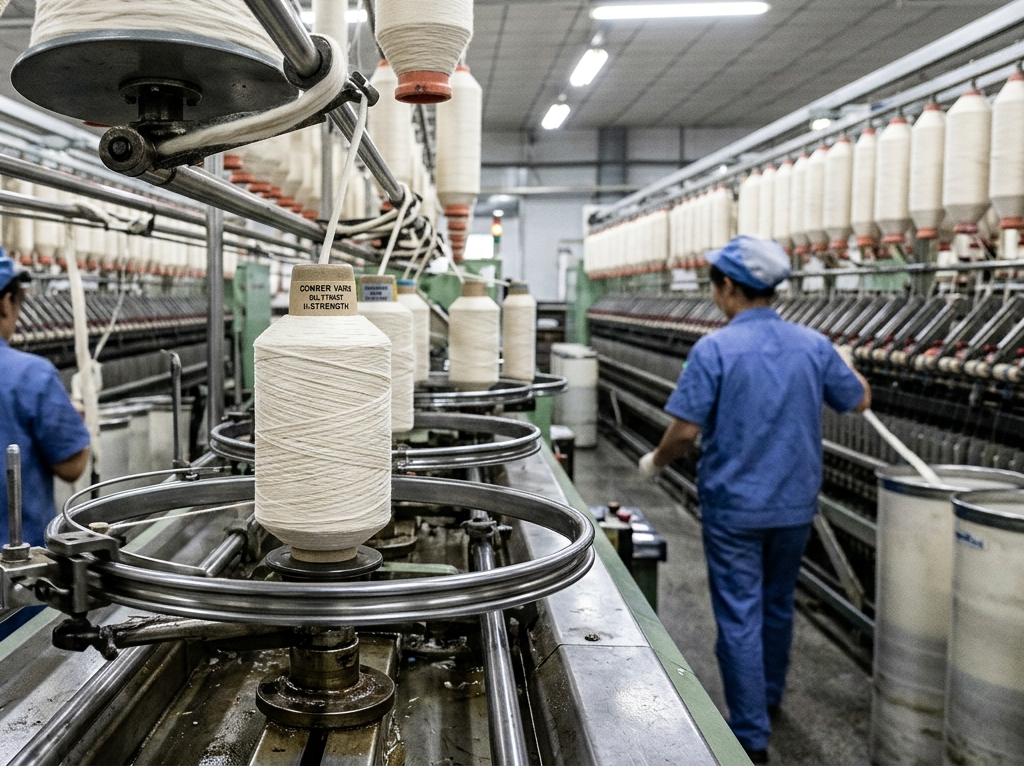
The creation of high-grade bedding begins long before fabric reaches the loom. The structural integrity, luster, and longevity of the final bed sheet are fundamentally determined by the raw fiber characteristics and the yarn spinning process.
1. Raw Fiber Grading and Selection
-
Fiber Staple Length: Premium bed sheets require extra-long staple (ELS) fibers (measuring 35mm or longer, such as Egyptian, Pima, or long-staple upland cotton) or engineered cellulosic fibers like Tencel™ (Lyocell) and bamboo viscose. Longer fibers result in fewer exposed end-points along the yarn, directly reducing surface pilling and boosting softness.
-
Micronaire & Strength Assessment: Raw fibers undergo High Volume Instrument (HVI) testing to measure fineness (micronaire) and tensile strength (grams per tex), ensuring the batch can withstand high-tension industrial weaving.
2. Opening, Cleaning, and Carding
-
Raw bales are opened and mechanically blended to smooth out natural variations between crops.
-
The carding machine uses wire-covered cylinders to align tangled fibers into a parallel web, removing trash, leaf fragments, and dust.
3. Mechanical Combing (The Quality Threshold)
-
For luxury linens, the carded sliver must pass through a combing machine.
-
This step removes short fibers (typically those under 12mm) and residual neps (tiny knots of tangled fiber). The combing process discards up to 15–20% of short-fiber waste, leaving only long, uniform fibers that produce smooth, lustrous, high-strength yarns.
4. Ring Spinning vs. Open-End Spinning
-
Ring Spinning: The industry gold standard for high-end bedding. Combed rovings are drawn out and twisted into fine, tightly spun single yarns (such as 40s, 60s, 80s, or 100s yarn counts). Ring-spun yarn features a uniform structure, high tensile strength, and minimal surface fuzziness.
-
Open-End (Rotor) Spinning: Faster and cheaper, but yields coarser, weaker yarn with a rough hand-feel. It is generally restricted to low-cost institutional items rather than retail luxury sheets.
Stage 2: Yarn Preparation & High-Density Weaving
Once fine yarns are spun, they must be engineered into greige fabric (raw, unbleached cloth) through precise yarn preparation and loom operations.
1. Warping, Sizing, and Beaming
-
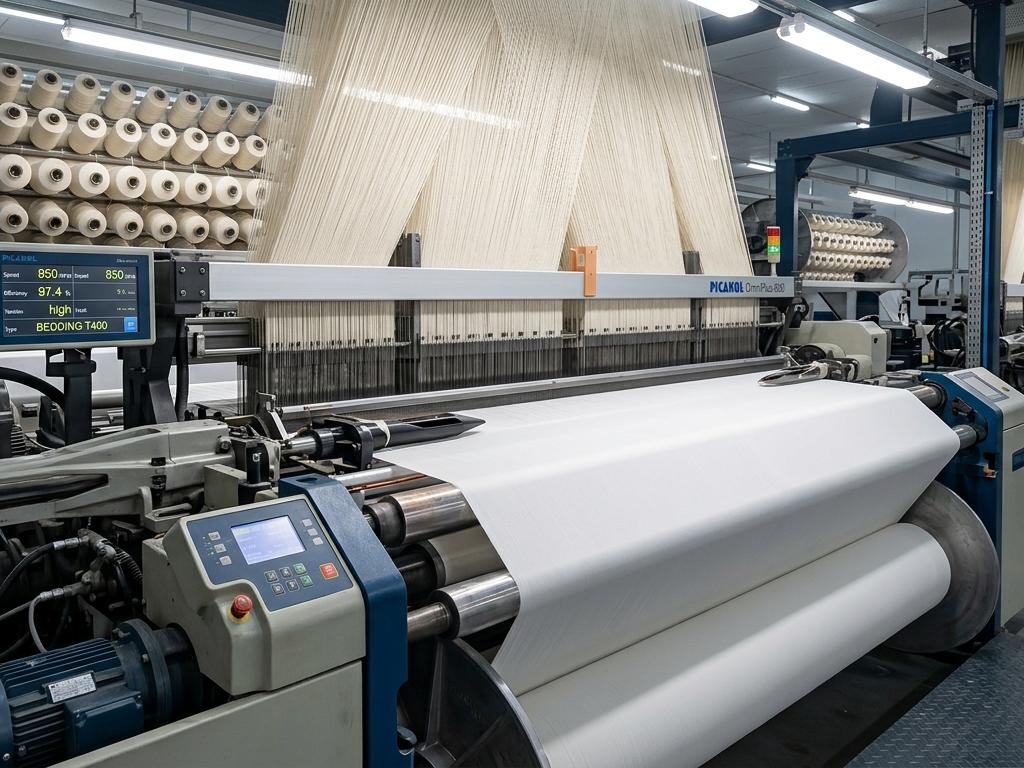
Warping: Thousands of individual yarn packages are wound onto a warp beam under uniform tension.
-
Sizing (Slashing): To prevent warp yarns from snapping under high-speed loom friction, yarns are coated with a protective water-soluble starch or synthetic size formulation.
-
Drawing-in: Every warp thread is individually threaded through a drop wire, heddle eye, and reed blade on the loom harness.
2. Weaving Technology: Shuttleless Air-Jet Looms
Modern textile manufacturing relies almost exclusively on high-speed air-jet looms or rapier looms for wide-width bedding production (up to 3.2 meters wide).
-
Air-Jet Insertion: A main nozzle and series of relay nozzles propel the weft yarn across the shed using high-pressure compressed air pulses at speeds exceeding 800 to 1,200 picks per minute.
-
Tension Consistency: Computerized tension sensors constantly adjust warp let-off and fabric take-up to prevent density banding (barré) or uneven cloth edges.
3. Weave Constructions in Bedding
-
Percale (Plain Weave): A classic 1-over-1-under structure yielding a crisp, matte, and highly breathable fabric with high structural stability.
-
Sateen (Satin Weave): A 4-over-1-under float structure that exposes more yarn surface, creating a signature silky sheen, drape, and buttery soft hand-feel.
-
Jacquard Weave: Produced using electronic Jacquard heads mounted above the loom, allowing individual warp control to weave complex geometric, damask, or floral patterns directly into the fabric matrix.
Stage 3: Wet Processing, Dyeing, & Advanced Finishing
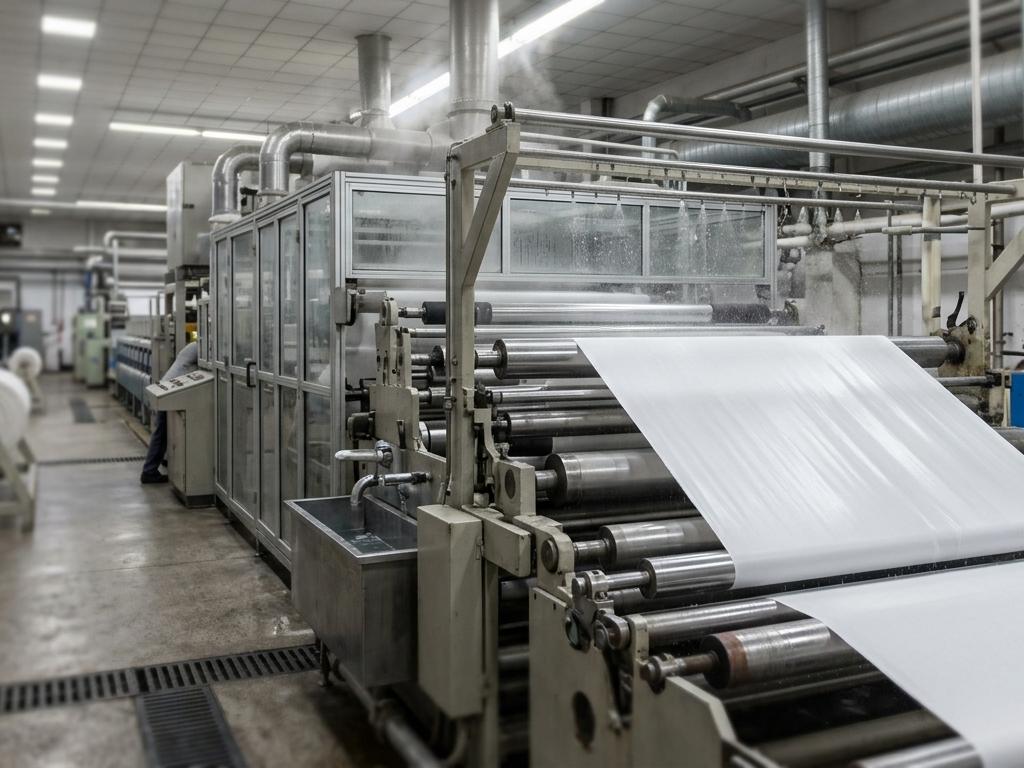
Raw greige fabric is stiff, yellowed, and water-repellent due to natural waxes and sizing agents. The wet-processing and finishing stage turns rough greige into smooth, vibrant, and dimensionally stable bedding fabric.
1. Singeing & Desizing
-
Singeing: Greige fabric passes rapidly over gas flames at high speed (100–150 meters/minute) to burn off protruding surface fuzz without scorching the base cloth. This creates a clean, pill-resistant surface.
-
Desizing: Enzyamtic baths break down the starch sizing agents added during warping, restoring the natural absorbency of the raw fibers.
2. Scouring & Bleaching
-
Scouring: The cloth is treated with hot alkaline solutions (caustic soda) to emulsify natural fats, oils, and pectin in the fibers.
-
Bleaching: Hydrogen peroxide bleaching removes natural organic pigments, whitening the fabric evenly to prepare it for pastel dyeing or crisp white hotel finishing.
3. Mercerization (Chemical Luster & Strength)
-
The fabric is pulled through a concentrated cold sodium hydroxide (NaOH) bath under heavy tension and then washed.
-
Microscopic Change: Mercerization causes flat, ribbon-like cotton fibers to swell into smooth, rounded cylinders. This permanent alteration increases fabric luster, enhances dye absorption by up to 20%, increases tensile strength, and reduces post-wash fabric distortion.
4. Dyeing & Printing
-
Reactive Dyeing: High-temperature continuous pad-steam or cold pad-batch dyeing uses reactive dyes that form covalent chemical bonds with the cellulose molecules. This yields exceptional color fastness to washing and crocking (rubbing) at Grade 4–5.
-
Digital / Rotary Screen Printing: Used for pattern bedding, utilizing non-toxic, Azo-free pigment or reactive inks.
5. Sanforization (Mechanical Pre-Shrinking)
-
The Process: The wet fabric passes through a heavy rubber belt mechanism heated by a steam drum. The rubber belt compresses the warp threads mechanically, forcing the fabric to shrink controlledly before it is cut.
-
The Result: Sanforization stabilizes the fabric structure, ensuring that finished bed linens exhibit a total shrinkage rate of less than ±3% after repeated commercial or residential laundering.
Stage 4: Fabric Inspection, Shade Sorting, & Precision Cutting
Once finished fabric rolls leave the finishing line, they are moved to the cutting room for preparation and sizing.
1. 4-Point System Fabric Inspection
Before cutting, 100% of fabric rolls are run across illuminated inspection frames using the international ASTM D5430 4-Point System. Defects such as dye streaks, slubs, or hole punctures are assigned penalty points per square yard. Rolls exceeding penalty thresholds are flagged and rejected.
2. Shade Sorting & Batching
Spectrophotometers measure color consistency across the left, center, and right edges of each roll. Fabrics are sorted into strict shade bands to prevent color variations within the same sheet set.
3. Computer-Aided Laying and Cutting
-
Relaxation Period: Elastic fabrics and knitted materials are unrolled and allowed to rest for 24 hours to relieve internal winding tension before cutting.
-
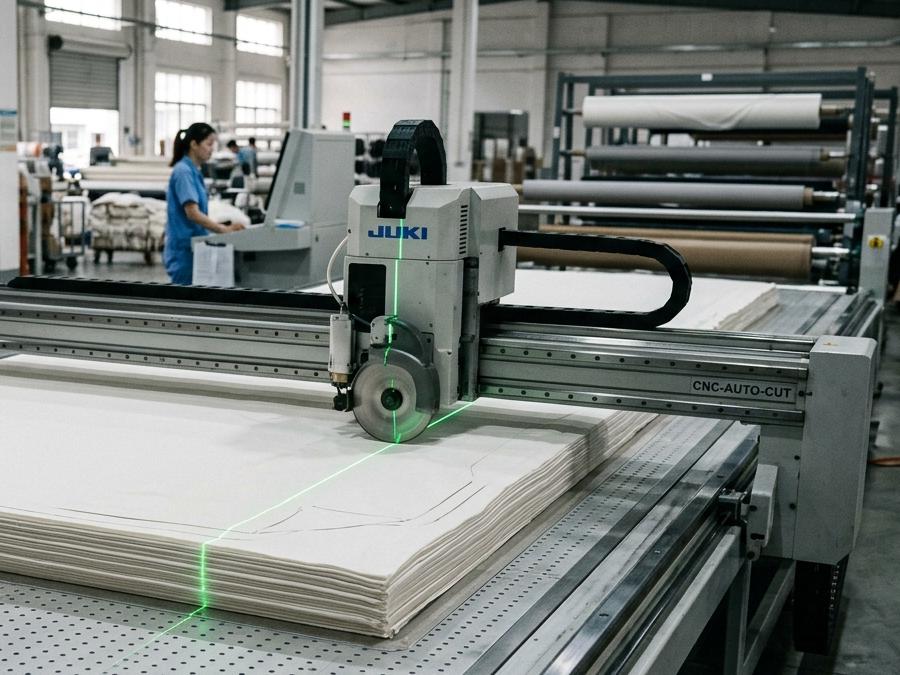
Automated Spreading: Computerized spreading machines layer up to 50–100 plies of fabric flat on vacuum-assisted cutting tables.
-
CNC / Laser Cutting: High-speed automatic CNC cutters or laser blades slice through multi-layered fabric plies with millimeter precision based on CAD marker layouts. Precision cutting ensures that panels remain straight along the grainline, preventing diagonal seam twisting after washing.
Stage 5: Precision Sewing, Hemming, & Structural Assembly
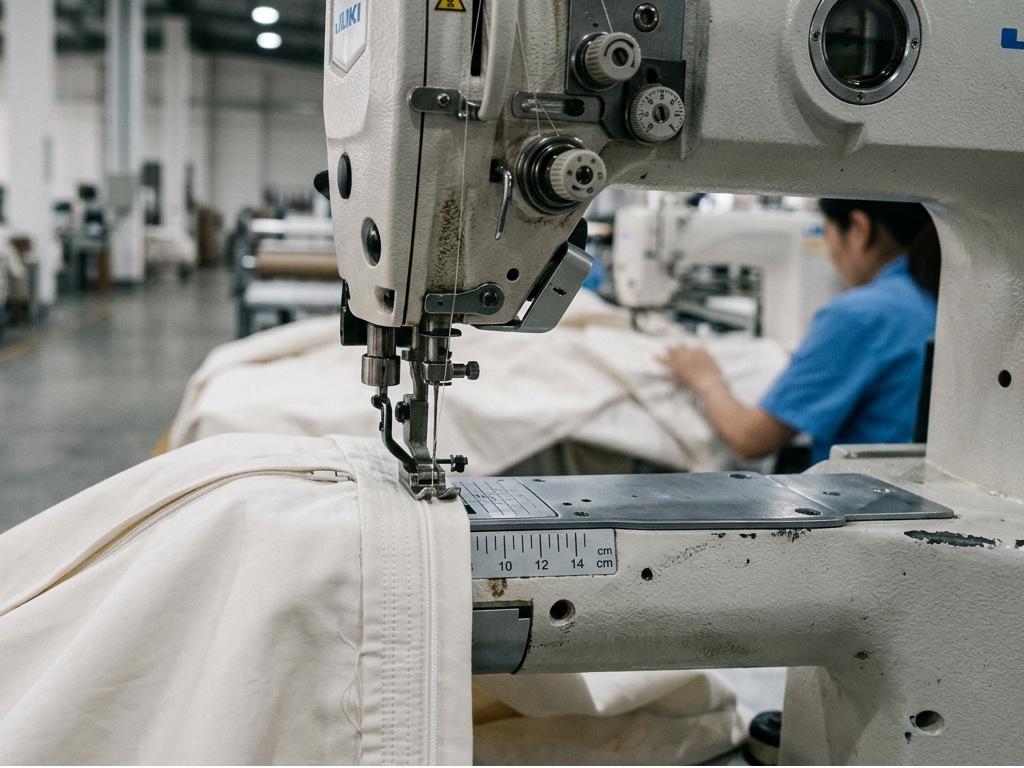
In the sewing assembly shop, flat cut panels are converted into 3D bedding components (duvet covers, fitted sheets, pillowcases, and bolster covers) by skilled operators using specialized industrial sewing machinery.
1. Stitch Density & Thread Engineering
-
Stitch Per Inch (SPI): Premium commercial manufacturing enforces a strict stitch density of 12 to 14 stitches per inch (2.5 cm). Stitching that is too loose (under 10 SPI) leads to seam gaping under tension; stitching that is too dense (over 16 SPI) can cause needle-chewing and fiber damage along seams.
-
High-Tenacity Thread: Sewing lines utilize continuous filament core-spun polyester or cotton-wrapped polyester threads to match fabric strength and shrinkage rates.
2. Specialized Component Assembly
-
Fitted Sheets: High-stress corners are joined using 5-thread safety overlock seams. A heavy-duty, heat-resistant elastic band (typically 1.0–1.2 cm wide) is double-stitched around the entire bottom perimeter (360-degree elastic) or within the 4 corners to fit deep mattresses securely.
-
Pillowcases: Edges feature clean 5cm–10cm wide self-fabric top cuffs with hidden internal envelope closures (15cm–20cm deep flap) or decorative French seams to hide raw edges completely.
-
Duvet Covers: Bottom openings are assembled with reinforced concealed zipper tracks (using auto-lock metal/nylon sliders) or heavy-duty heat-resistant resin buttons. Internal corner ties (4 to 8 locations) are double-bar-tacked to lock the comforter insert in place.
Stage 6: Multi-Tier Quality Control
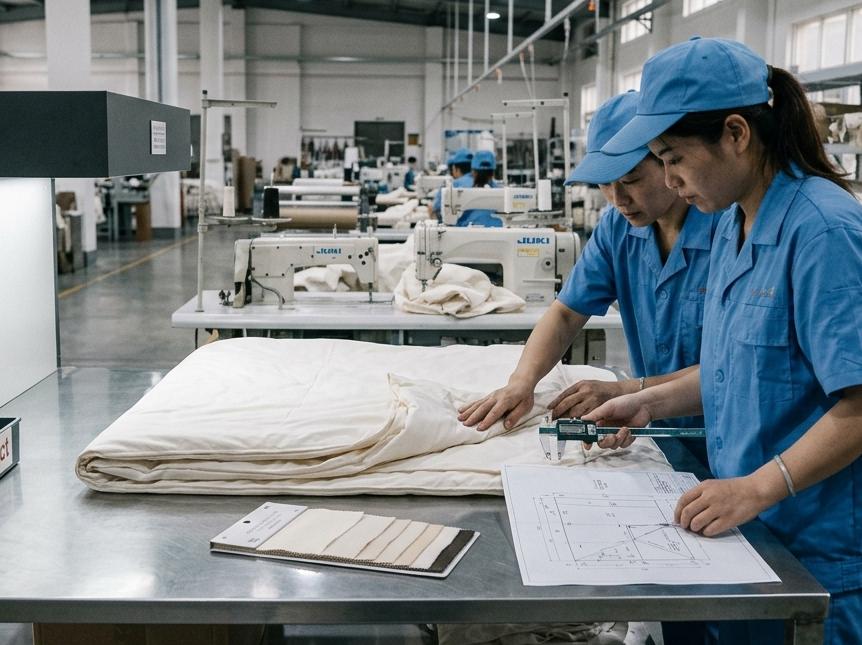
Quality control is not a single end-of-line event—it is a continuous monitoring process integrated across the assembly floor.
1. In-Line Quality Audits
Inspectors conduct random checks at active sewing stations, auditing seam allowances, thread tensions, hem straightness, and dimensional accuracy against master tech packs.
2. 100% Off-Line Light-Table Inspection
Every sewn garment is placed on an illuminated inspection table. QC staff perform manual checks for:
-
Loose thread tails, skipped stitches, or broken sewing threads.
-
Surface spot contamination, oil marks, or minor color shading.
-
Dimensional variance outside approved tolerance windows (typically ±1 cm for sheets).
3. Final AQL 2.5 Audit
Completed batches are subjected to final random sampling based on the ISO 2859-1 / ANSI/ASQ Z1.4 (AQL 2.5) standard. A statistical sample of finished boxes is opened and evaluated for critical, major, and minor defects before releasing the lot for packaging.
Stage 7: Industrial Ironing, Needle Detection, & Sustainable Packaging
The final packaging stage prepares bed linens for retail shelf presentation and ocean shipment while ensuring safety compliance.
1. Industrial Tunnel Steam Ironing
Finished products pass through automated continuous steam tunnels or heavy-duty flatbed steam presses. High-temperature steam removes sewing wrinkles, sanitizes the fabric, and gives linens a crisp, retail-ready finish.
2. Mandatory Needle Detection
Every single finished product passes through a high-sensitivity dual-head conveyorized needle detector machine (calibrated to detect ferrous metal fragments down to 0.8mm–1.0mm). This guarantees that no broken sewing needle fragments remain embedded in the bedding, preventing end-user injuries and liability claims.
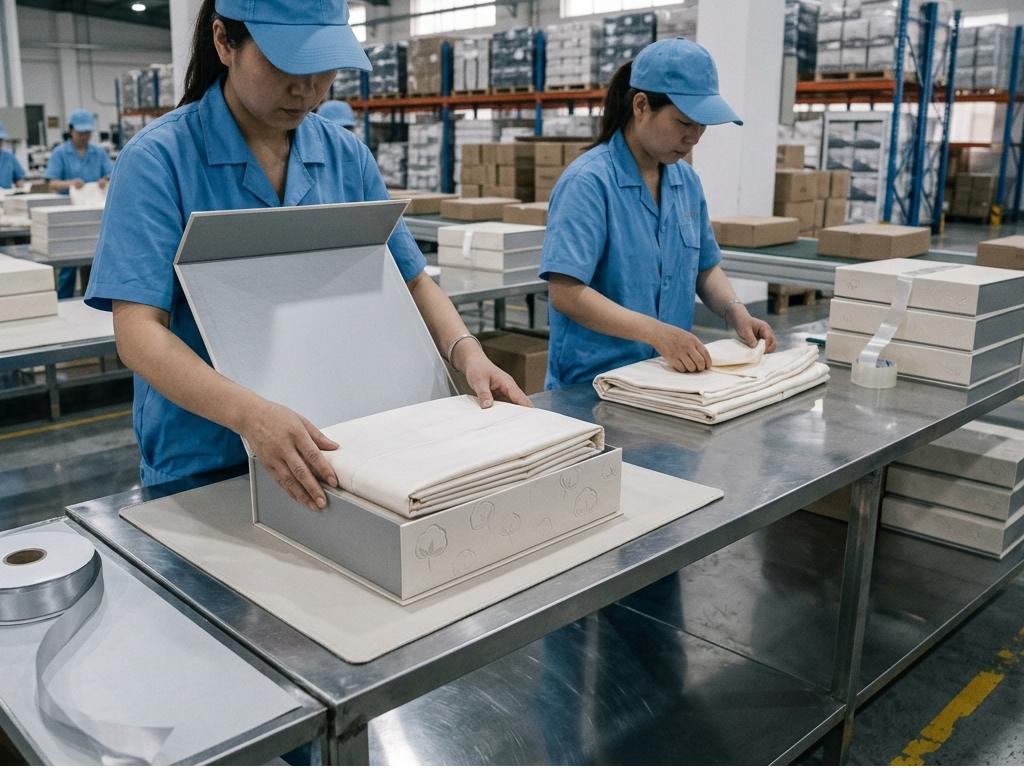
3. Retail Packaging & Export Carton Packing
-
Packaging Options: Products are folded over stiff inner paperboards and placed inside OEKO-TEX certified PVC/EVA zip bags, FSC-certified kraft paper bands, or eco-friendly self-fabric tote bags.
-
Barcode & Tagging: Accurate SKU barcodes, care labels, fiber content tags, and law labels are attached according to destination market regulations (such as FTC guidelines in the US or EU textile labeling rules).
-
Master Cartons: Packed goods are loaded into heavy-duty 5-ply or 7-ply corrugated export cartons, sealed with reinforced tape, and strapped for containerized sea or air transit.
Comprehensive Manufacturing Quality Control Checkpoints
| Production Stage | Primary Machinery Used | Core Technical Parameter | Defect Prevented |
| Spinning | Combing Machine, Ring Spinning Frame | Fiber length >35mm, 15-20% short fiber removal | Surface pilling, low tensile strength, yarn slubs |
| Weaving | Computerized Air-Jet Loom | 800-1200 picks/min, uniform warp tension | Barré (density stripes), missing ends, loose weave |
| Finishing | Gas Singeing, Mercerizer, Sanforizer | Cold NaOH bath, mechanical pre-shrinking | Wash shrinkage >3%, dull color, fiber pilling |
| Cutting | CNC Automatic Multi-Ply Cutter | Vacuum bed compression, laser grainline alignment | Diagonal twist after wash, mismatched dimensions |
| Sewing | Heavy-Duty Lockstitch & Overlock Machines | 12-14 stitches/inch (SPI), 5-thread safety serge | Seam bursting, loose threads, elastic snapping |
| Final QC | Light Table, Dual-Head Needle Detector | AQL 2.5 sampling, 0.8mm metal detection limit | Needle contamination, oil spots, sizing errors |
Elevate Your Sourcing with Our Manufacturing Capabilities
Understanding the multi-stage complexity of home textile manufacturing highlights why selecting the right production partner is critical to your brand's reputation and bottom line.
As a technical B2B home textile manufacturer, we translate these rigorous industry standards into custom, high-performance manufacturing solutions for private-label retail brands, hotel distributors, and global importers:
-
Custom Fabric & Size Engineering: We offer full OEM/ODM customization—from 300TC to 1000TC combed cottons, cooling Tencel-nylon jacquards, and plant-dyed organics to regional size configurations (including deep-pocket fitted sheets and matching bolster cases).
-
In-House Laboratory Testing: Every production lot is backed by our internal textile testing lab, verifying color fastness, tensile strength, and shrinkage rates to maintain a factory defect rate under 0.5%.
-
Full Supply Chain Transparency: We provide complete, traceable certification packages—including OEKO-TEX Standard 100, GOTS, GRS, and BSCI audits—ensuring smooth, hassle-free customs clearance in US and EU ports.


